
Galena Community Data Report Summer 2026
Project Overview
The Alaska Department of Environmental Conservation’s (DEC) Air Monitoring and Quality Assurance program began deploying low-cost air quality sensors in communities throughout Alaska in 2023. This has allowed DEC to provide real-time air quality data to the public in more than just the communities with regulatory grade air monitoring. While the data collected from these low-cost air quality sensors does not meet rigorous regulatory requirements and should not be compared to regulatory instruments or health-based standards, the data collected by the sensors are useful for tracking real-time conditions and displaying air quality trends. Low-cost sensor technology is rapidly evolving and data quality and accuracy varies across manufacturers and environmental conditions.
DEC currently utilizes QuantAQ Modulair and QuantAQ Modulair-PM sensors in the Community-Based Air Monitoring Network. Both sensor types provide measurements of ambient PM2.5 and PM10 concentrations. Sensors also include internal temperature and relative humidity sensors, which are not representative of ambient conditions but are used to support device troubleshooting. The Modulair additionally measures carbon monoxide (CO), ozone (O3), nitrogen oxide (NO), and nitrogen dioxide (NO2), but DEC only displays PM2.5 and PM10 data collected by both sensor types.
Sensor Overview and Results
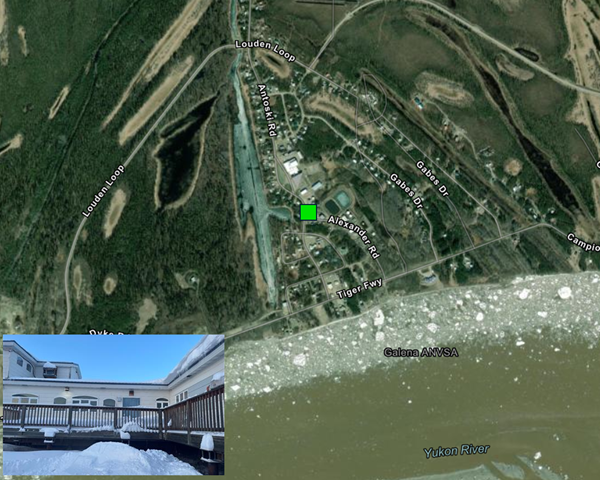
A sensor was installed in Galena at 149 Antoski Rd. Galena, AK 99741 on September 27, 2023.
This data report covers air quality in Galena in Summer 2026 from April 1, 2026 to September 30, 2026.
Galena’s ambient air quality for the Summer 2026 season had:
-
101 days in the Good air quality index (AQI) category
-
1 days in the Moderate AQI
-
0 days in the Unhealthy for Sensitive Groups AQI
-
0 days in the Unhealthy AQI
-
0 days in the Very Unhealthy AQI
-
0 days in the Hazardous AQI
Sensor Performance
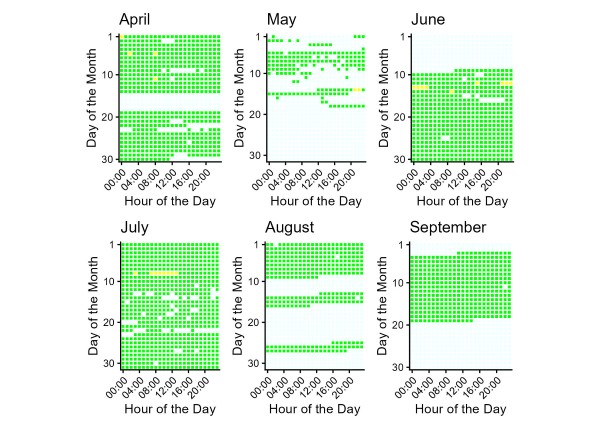
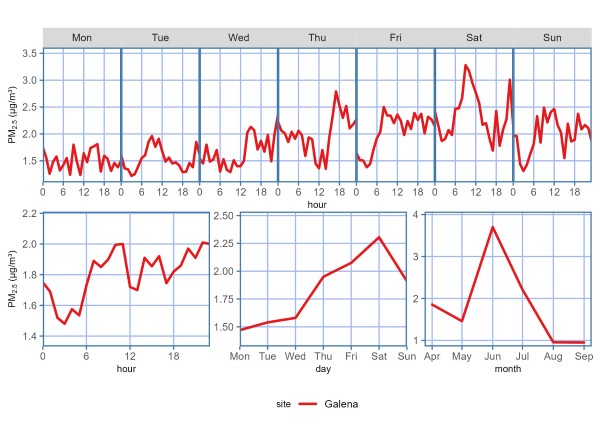
Galena’s ambient PM2.5 air quality for the Summer 2026 season was predominantly in the Good range of the Air Quality Index (AQI), with 1 day classified as Moderate and no days reaching higher AQI categories. Periods of power and/or network connection loss resulted in data gaps during the monitoring season, reducing the amount of data available for analysis. The hourly AQI calendar shows generally Good hourly conditions during the available monitoring periods, with limited data coverage in May, August, and late September. The diurnal pattern shows median PM2.5 concentrations increasing slightly during the afternoon and evening hours, while June had the highest median concentrations overall. The mean 24-hour PM2.5 concentration was 2.7 µg/m3, while the mean 24-hour PM10 concentration was 7.7 µg/m3.
Hourly PM2.5 Air Quality Index (AQI) for Summer 2026

Median PM2.5 Concentrations for Summer 2026
Summary Statistics of Air Pollutants
| Statistic | 1-hour PM2.5 | 24-hour PM2.5 | 1-hour PM10* | 24-hour PM10* |
|---|---|---|---|---|
| Units | (µg/m3) | (µg/m3) | (µg/m3) | (µg/m3) |
| Minimum | 0 | 0.3 | 0.1 | 1.7 |
| Mean | 2.4 | 2.7 | 7.9 | 7.7 |
| Median | 1.8 | 2.2 | 5.5 | 6.2 |
| 1st Max | 28.3 | 10.2 | 472.7 | 17.4 |
| 2nd Max | 21.5 | 10.2 | 184.4 | 16.7 |
Data Disclaimers
These statistics are based on preliminary data readings and are intended to provide a brief overview of sensor activity. Data may be obtained upon request. Data from the community sensor network is non-regulatory and not comparable to the EPA’s National Ambient Air Quality Standards (NAAQS).
*PM10 particle sensors can be influenced by periods of high humidity, including fog and ice fog, due to hygroscopic interference. Essentially water particles are counted as PM10, creating false maximum values that do not necessarily pose health risks. DEC currently filters out PM10 readings that exceed 500 µg/m3, though is working on methods to better filter out data affected by fog and ice fog.
Gaseous measurements (CO, O3, NO, and NO2) have not consistently met data quality standards set forth in DEC’s Quality Assurance Project Plan, and DEC began discontinuing public display of these measurements in August 2026. Multi‑year monitoring across the state showed gaseous pollutant levels remained low, and while these measurements provided useful insight into localized trends and baseline conditions, their long‑term consistency was not sufficient to support continued real‑time public reporting. DEC is in the process of retiring all QuantAQ Modulair sensors in the network and replacing them with QuantAQ Modulair-PM sensors.
Historic reports containing gaseous pollutant data will remain available at Community-Based Air Monitoring Project website with datasets available upon request to AMQA-Data-Request@alaska.gov.
Community Partner
The sensor is hosted at Galena City Hall in partnership with the Louden Tribe.

Resources
Alaska Department of Environmental Conservation
Real-Time Air Quality Index (AQI) Data
EPA National Ambient Air Quality Standards (NAAQS) Information
Data Access
Data may be obtained upon request, please email a request to AMQA-Data-Request@alaska.gov. Data will be provided in Excel or .csv format.
Questions or Comments?
Please contact us!
Isaac Van Flein (Fairbanks): 907-451-2253 / Isaac.VanFlein@alaska.gov
Ayla Crosby (Anchorage): 907-269-7750 / Ayla.Crosby@alaska.gov
 Indicates an external site.