FAQ: Splitting Fairbank North Star Borough (FNSB) PM2.5 Nonattainment Area into Fairbanks and North Pole Air Quality Areas
Summary
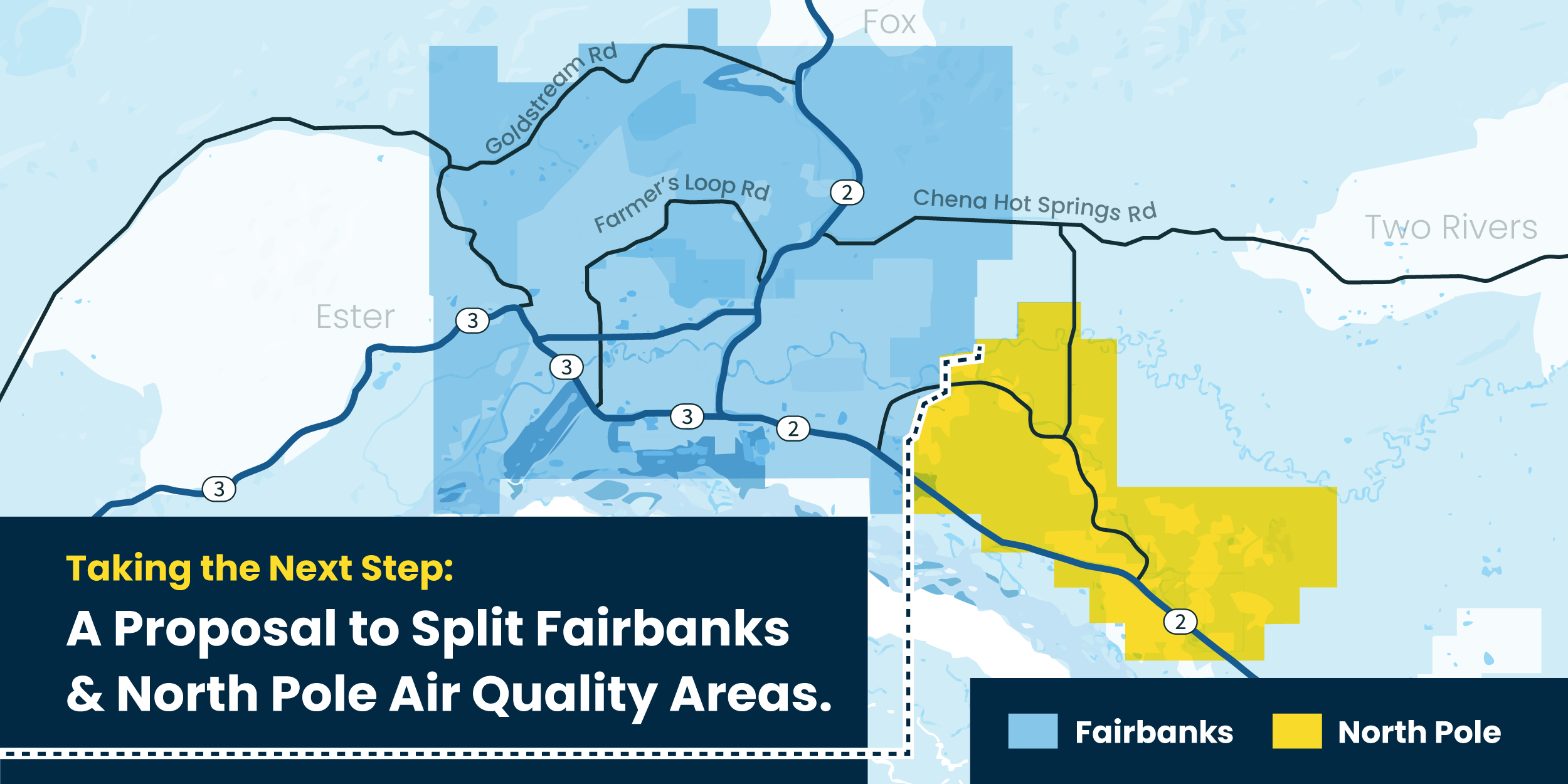
DEC is proposing to split the Fairbanks North Star Borough 24‑hour PM2.5 nonattainment area into two air quality areas: the North Pole AQCZ (covering North Pole and nearby neighborhoods with ongoing winter PM2.5 violations) and the Fairbanks–Goldstream Valley AQCZ (covering the City of Fairbanks, Goldstream Valley, and surrounding areas currently attaining). This request supersedes DEC’s November 20, 2015 split request, which DEC asked EPA to hold in abeyance on June 1, 2018.
DEC is proposing to separate our air quality areas to better match local conditions with local solutions. See what this means for your neighborhood and how to share your voice.
Right now, Fairbanks and North Pole are grouped together under the same winter air quality rules, even though winter air pollution is not the same in both places. For North Pole residents, this split would not create any immediate requirements for updating households’ heating systems. Any future changes would come later, through additional planning, public input, and rulemaking.
- No final decision has been made yet. DEC expects public comment in summer 2026.
- No immediate household changes would happen if the areas were split.
- Under the proposal, the split would happen roughly along Badger Road.
- North Pole could be prioritized for future support such as device replacement, weatherization, or natural gas connection where feasible.
Frequently Asked Questions
Select question below to show answer.
Background Context
- Why is DEC proposing to separate Fairbanks and North Pole into two air quality areas?
- Winter fine-particle pollution, called PM2.5, is often more concentrated in parts of North Pole than in Fairbanks. DEC’s air monitoring has shown that the two communities do not experience the same winter air quality conditions. DEC is proposing to separate the areas so that future actions and support can better align with what is happening in each community.
- Why are Fairbanks and North Pole being treated differently?
- Because air pollution levels are not the same across the current area. During winter inversions, pollution levels are often higher in the North Pole area. Treating communities separately would allow DEC and local partners to provide more targeted support and to plan future measures based on local conditions.
- How is air quality measured, and why are monitors located where they are?
- DEC measures winter PM2.5 using a network of neighborhood-scale monitors in the Fairbanks North Star Borough, including sites in Fairbanks and North Pole. These monitors are placed to represent local conditions for public health alerts, long-term trend tracking, and Clean Air Act requirements. DEC also conducted a North Pole saturation study in 2017 to confirm that the Hurst Road monitor reflects neighborhood conditions and does not need to be moved.
- How do I know whether I live in the Fairbanks area or the North Pole area?
- Under the proposal, the split would happen roughly along Badger Road. The Fairbanks North Star Borough also maintains boundary maps that can help residents see which area they are in.
- What could change for residents in North Pole?
- There would be no immediate changes for residents. Over time, North Pole may need to go through additional planning and consider more ways to reduce pollution. That could include prioritized support, such as stove replacement, weatherization, or natural gas connection, where available. It could also include future requirements, such as limits or deadlines for some older, higher-polluting wood stoves. Any future changes would go through a public process.
- What could change for residents in Fairbanks?
- There would be no immediate changes for residents. Over time, Fairbanks could face fewer restrictions than if it remained tied to North Pole’s air quality. Some incentive programs may also be focused more heavily on North Pole if that area is prioritized for future support.
Real World Impact
- What does this proposal mean for my household right now?
- No immediate changes would happen to your household or heating device simply because the area is split. Any future changes would come later, through additional planning, public input, and rulemaking.
- Has a final decision been made yet, and when will public comment happen?
- No. DEC expects to take public comment in summer 2026. When the comment period opens, DEC will publish the public notice, proposal documents, and instructions for submitting comments on the DEC Air Quality website and the State’s Online Public Notices website. This landing page will also be updated.
- What happens during extreme cold, when households need to stay warm?
- DEC’s Emergency Episode Plan and related rules are designed to balance public health protection with the community’s need for adequate heat. DEC also has a waiver system for residents whose only adequate heat source is a wood stove, and staff can help residents work through unique situations.
Next Steps
- What kinds of household help or funding could be available?
- Under the proposed split, North Pole households could be prioritized for support such as device replacement (see the borough’s wood stove change-out programs), weatherization, or natural gas connection, where feasible. Program details would depend on future funding and future program design.
- Would accepting funding require giving up a wood stove?
- It depends on the program. Some assistance programs require removing or permanently disabling older, smokier devices and replacing them with an approved stove/heater that creates less smoke. Program terms would be listed in the specific program announcement.
- Are there deed restrictions or other conditions tied to assistance?
- Sometimes, yes. Deed restrictions are generally used when a program provides substantial financial assistance—sometimes enough to cover most or all the cost of replacing older equipment. The purpose is to help prevent fraud and ensure public investment leads to lasting air quality benefits. Program requirements can vary, so residents should review the terms of any specific program before applying.
- Who can I contact if I have questions?
- Questions can be directed to DEC Burnwise
 Indicates an external site.