Investigating the Selawik River: Learning More About Alaska's Waters
Written by Jeff Fisher, DEC, with assistance from DEC's Selawik monitoring team
October 11, 2023
What do you get when you take seven scientists and plop them down in the middle of a remote Alaska National Wildlife Refuge on a gravel bar within the boreal banks of a Wild & Scenic River with three rafts, a boatload of sampling equipment, and a birthday cake in a shoe box? An extensive water quality assessment trip, helping to inform the overall health of one of the state’s many culturally and ecologically significant rivers, of course!
This past summer, seven scientists, including six from the Alaska Department of Environmental Conservation (DEC) and one from the Alaska Department of Fish & Game (ADFG), embarked on a helicopter flight to the remote Selawik National Wildlife Refuge located in northwest Alaska. The crew conducted baseline water quality surveys as they floated the Selawik River in three inflatable boats, along a 60-mile reach within the 150-mile designated Wild & Scenic stretch, about 100 miles southeast of Kotzebue.

Aerial photo of the Selawik River taken from a helicopter. Photo by Morgan Brown.
The Selawik River, named after the Inupiaq word "Siivik," meaning "place of sheefish," is a vital ecosystem for this keystone species and the indigenous communities that rely on it for subsistence and culture. Originating in the Purcell Mountains, the Selawik River starts in upland boreal landscapes with swift, clear water currents and gravel channel bottoms. In the lower reaches the Selawik River takes on a tannic color as it slowly meanders through tundra ecosystems, before emptying into the Chukchi Sea approximately 250 miles later.
The timing for this water quality survey was just right as the U.S. Fish and Wildlife Service is wrapping up a long-term fish study in the area. DEC realized not much is known about the water quality and took advantage of this perfect opportunity to collect data on this important river. DEC’s Selawik River assessment work is part of the Environmental Protection Agency's (EPA) 2023 National Rivers and Streams Assessment—a comprehensive program evaluating baseline conditions of waterways across the United States.
The crew left no detail unexamined, collecting data on riparian vegetation, large woody debris abundance, river channel characteristics, water quality, and aquatic insect abundance. Fourteen of the 35 randomly designated sites were surveyed along a 60-mile section of river. The field crew observed several fish species including sheefish, slimy sculpin, northern pike and arctic graying. Wildlife observed included moose, beavers, Kingfishers, northern water thrush, dark-eyed juncos, great-horned owls, bald eagles, and plovers to name a few.
Over the coming months DEC staff will be evaluating the data and writing a results report that will be available on DEC’s website. The data will also be submitted to a publicly available national database and become part of the 2023-2024 National Rivers and Streams Assessment. “Ultimately, we would like to be able to use these data as baseline information for future comparisons, and to create metrics that we can use to understand the health of Alaska’s waters,” said DEC environmental program specialist and Selawik field crew member Morgan Brown.
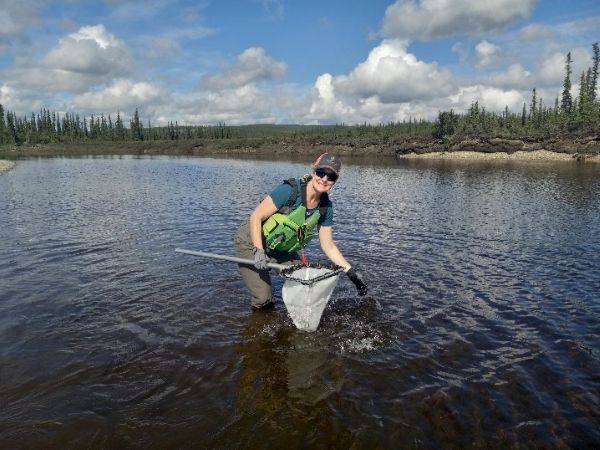 DEC Environmental Program Specialist, Maryann Fidel, collects small invertebrates from the Selawik River. Photo by DEC staff.
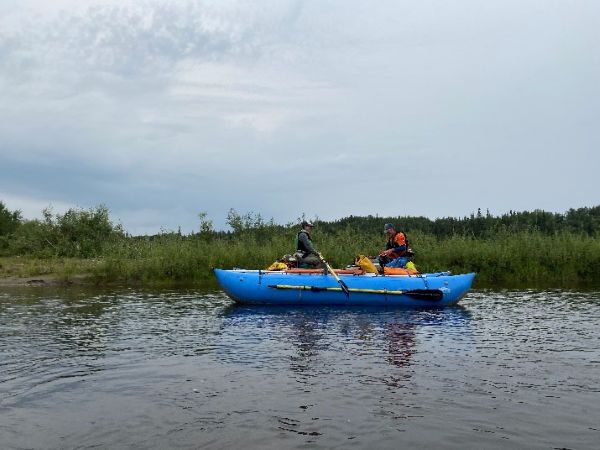 DEC staff Chandra McGee (left) and Brock Tabor (right), floating the Selawik River on a cataraft. Photo by DEC staff.
Amidst their rigorous work, the team celebrated Brown's birthday in true field crew fashion, with a surprise Mediterranean-style chicken dinner, a homemade birthday cake transported in a shoebox, and festive shark party hats. “That was the most remote birthday I'll probably ever celebrate!" said Brown.
Alaska's vast river network, totaling over 365,000 miles, surpasses the combined river mileage of all other U.S. states. These rivers are essential for pollution filtration, nutrient cycling, fish and wildlife habitat, and regional water distribution. A deeper understanding of river health informs critical decisions at the local, state, and federal levels. The monitoring and assessment efforts by the DEC and partners of the Selawik River and other rivers in the state are critical for the continued stewardship of Alaska’s freshwater resources for generations to come.
For more information on the DEC’s surface water monitoring and assessment please contact Terri Lomax. Funding for this project was provided in part by the U.S. EPA.
 Indicates an external site.