Vanderbilt Creek: An Urban Oasis of Resilience and Beauty
Written by Jeff Fisher, DEC, with assistance from DEC water quality specialist Gretchen Augat.
November 1, 2023
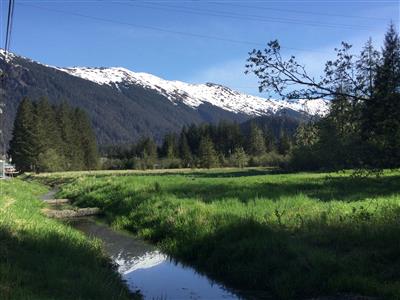
A rehabilitated streambank located on the Southeast Alaska Land Trust’s Vanderbilt Creek conservation property. Photo by DEC staff Gretchen Augat.
Vanderbilt Creek, nestled along the southeastern edge of the Lemon Creek Valley in picturesque Juneau, Alaska, is a resilient waterway within an ever-evolving urban environment. Since the early 1900s, this area has witnessed a transformation from logging and homesteading to commercial and industrial development. Despite these practices, Vanderbilt Creek continues to provide critical habitat for a myriad of fish and wildlife species that make the area ecologically rich.
“Vanderbilt Creek is small yet mighty!”, said Gretchen Augat, a water quality specialist at the Alaska Department of Environmental Conservation (DEC). In many places, the creek is so narrow that you can effortlessly step across it, but don’t let its narrow channel fool you. During the spawning season, you can see hundreds of chum, coho, sockeye, and pink salmon, charging up in search of spawning grounds causing quite the spectacle.
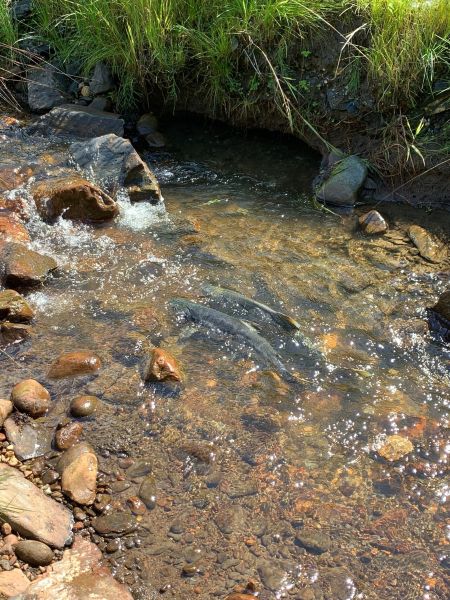
A pair of chum salmon stage mid-channel in Vanderbilt Creek preparing to spawn. Photo taken by DEC staff.
Although a very productive salmon stream, Vanderbilt Creek is listed as an impaired waterbody by DEC due to pollutants from roads and parking lots that are transported to the stream in stormwater runoff. This water pollution can be harmful to fish and wildlife.
Since at least 1993, dedicated efforts by several organizations have been in place to monitor and restore Vanderbilt Creek. Because of all the restoration efforts, in 2022-2023, DEC conducted extensive water quality monitoring, focusing on parameters such as turbidity, dissolved oxygen, specific conductivity, pH, water temperature, and settleable solids. Having this updated water quality information will provide helpful information on the health of the stream and whether water quality has improved due to better stormwater management practices.
DEC is currently evaluating the data results and will post a final report to our webpage. If the data shows that Vanderbilt Creek is now meeting water quality standards, DEC will pursue removing the impairment status. However, if water quality still needs some work, DEC will continue to work with area partners on ways to improve the creek’s health.
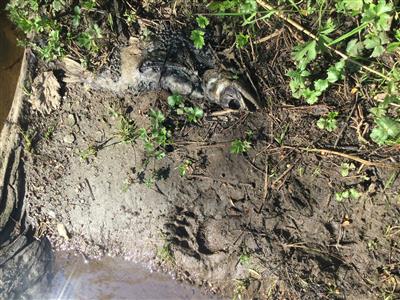
Brown bear tracks and a rotting salmon carcass along the banks of Vanderbilt Creek. Photo by DEC staff Gretchen Augat.
“I’ve enjoyed weekly sampling on Vanderbilt Creek the past two field seasons,” Augat explained. “It’s fascinating to see how the creek changes with seasonal storms, spawning, and wildlife during my frequent visits.”
We thank all the businesses, organizations, and local citizens that are working to help protect and improve water quality in Vanderbilt Creek. This urban stream is a testament to nature's enduring resilience and is a reminder for the need to protect and value our natural surroundings that are right in our back yard.
 Indicates an external site.