North Pole Refinery Contamination Response At A Glance 2026
April 2026
Contents
- Recent Project Milestones
- New to Town?
- Water System Update
- Addressing PFAS on the Former Refinery
- Groundwater Advisory
- Recent Sampling Results
- Brief History
- Continued Oversight
- NTP Studies Continue
- Map of the sulfolane plume
- Map of groundwater sampling for PFOS & PFOA
- Key Contacts
See the PDF version of this fact sheet
This is an update for North Pole residents and others interested in the state’s response to contamination from the former North Pole Refinery.
Recent project milestones
In the Know!
Sulfolane – a specialized industrial chemical used by the refinery to make gasoline. The health effects of long-term exposure to sulfolane are not known and are currently being studied by the National Toxicology Program (NTP).
PFAS – a large and complex class of human-made chemicals. They are found in firefighting foams and many consumer products. PFAS have a wide range of toxicities. The most well-studied PFAS include PFOS and PFOA, although the U.S. Environmental Protection Agency (EPA) continues to study all PFAS.
- In 2024 and 2025, former refinery owner Williams Petroleum Alaska (Williams) contacted property owners for possible alternative water supplies. Properties with sulfolane in their well water may be eligible for connection to municipal water or alternative water. Although all eligible and willing property owners were connected to the City of North Pole’s expanded piped water system by 2020, it is possible that other properties may now be eligible to receive water. This work will continue in 2026.
- DEC’s Groundwater Advisory informs affected community members about impacts from the remaining groundwater contamination.
- In fall 2025, Williams initiated a pilot test of a potential remedy to address per- and polyfluoroalkyl substances (PFAS) in groundwater on the former refinery property. In 2024, Williams also removed some soil contaminated above allowable levels from the former refinery property.
- Annual (or more often) groundwater monitoring, under DEC oversight, continues to track movement and concentrations of the sulfolane plume both on and off the former refinery.
- On the national level, the National Toxicology Program continues research regarding the toxicity of sulfolane.
- On April 10, 2024, the U.S. Environmental Protection Agency (EPA) adopted a National Primary Drinking Water Regulation (NPDWR) establishing Maximum Contaminant Levels for six PFAS and a cumulative risk level for the sum of four PFAS. The Division of Spill Prevention and Response (SPAR) is reviewing the EPA’s recently adopted NPDWR for PFAS and evaluating the potential impacts to PFAS-contaminated sites throughout the state. For more information on EPA's announcement, please visit EPA's PFAS website.
New to Town?
- DEC encourages you to see where you live relative to the sulfolane plume. If you live within it, you are urged to find out the source of your water supply (see map at the end of this fact sheet).
- Check out these North Pole Refinery pages for updated maps and detailed information about the contamination.
- Go to the City of North Pole's utility website for information about the municipal water system.
Water System Update
In fall 2024, Williams began to evaluate properties near the former refinery for alternative water supplies (AWS), under a DEC-approved work plan. Owners of properties that are within or near the sulfolane groundwater plume and not connected to municipal water are being contacted by Williams or their consultants annually. Wells with detectable levels of sulfolane may be eligible for AWS or connection to city water.
In 2018-2020, the City of North Pole expanded its water system to include properties impacted by the sulfolane plume, within and outside the city limits. By the end of 2020, all eligible property owners were offered connection to the service and able to phase out the use of contaminated groundwater wells. Most property owners were eligible to connect at no cost, depending upon the land’s location and improvement status. Of 730 eligible properties, 652 connections were made.
The piped water system is a comprehensive way to eliminate exposure to sulfolane in drinking water. The City of North Pole's public water system is regulated by the State's Drinking Water Program, which requires compliance with state and federal drinking water regulations. The Program reviewed and approved the design of North Pole’s water expansion project.
Groundwater Advisory
In November 2018, DEC issued a Contaminated Groundwater Advisory to all property owners within North Pole’s water expansion area, where many private water wells contain sulfolane and/or PFAS.
The advisory helps residents avoid unintentional contact with, or spreading of, the chemicals present in well water.
DEC advises against using untreated, contaminated well water for all use, including but not limited to drinking, cooking, bathing, or household uses, as well as gardening, lawn watering, car and equipment washing and other outdoor uses. Bringing contaminated well water to the surface may expose people and animals to chemicals in the water. Using contaminated well water may also allow chemicals in the water to spread onto other properties, sloughs, or ponds.
In issuing this advisory, DEC is seeking the community’s assistance in minimizing the future spread of these contaminants.
Addressing PFAS on the Former Refinery
Recent sampling shows PFAS above DEC’s soil and groundwater cleanup levels on the former refinery property and PFAS in groundwater above DEC’s action level are migrating off the property (see map). In late 2024 Williams removed approximately 1,900 tons of soil containing PFAS from a former fire training area on the property. Post-excavation sampling showed a small area of soil remaining above the cleanup level; this contamination is to be addressed in 2026.
In late 2025, Williams initiated a pilot study, under a DEC-approved work plan, to remove PFAS from groundwater on the refinery. The pilot test evaluation is ongoing through 2026.
An evaluation of ecological risk from PFAS on the former refinery property is being conducted in 2026 under a DEC-approved work plan.
Recent Sampling Results
Off the former refinery: Based on samples collected annually through 2024, the sulfolane plume shows no evidence of migrating beyond the area served by municipal water. Questions remain regarding sulfolane travel pathways below the permafrost. See map below.
On the former refinery: Based on samples collected from wells near the property boundary at least annually through 2024, petroleum concentrations are below Alaska cleanup levels, and sulfolane concentrations are below the allowable limit. Sulfolane and petroleum contamination remain on the property and continues to naturally degrade over time.
- In addition to the maps below, other maps of the site are available on the Maps page.
Brief History
The North Pole Refinery operated from 1977 until 2013. During that time, many spills and leaks of industrial chemicals and wastewater contaminated the soil and groundwater on the refinery property. Spilled substances included petroleum products, sulfolane, and PFAS. Over time, sulfolane and PFAS in the groundwater migrated off the refinery property, eventually extending 3.5 miles to the north-northwest.
In 2009, sulfolane was detected in drinking water wells north of the refinery. Under DEC oversight, then-owner of the refinery, Flint Hills Resources Alaska (FHRA), provided new water wells for the city of North Pole and alternative water supplies to affected residents. They also completed intensive characterization activities to investigate the source and extent of the sulfolane contamination.
In 2017, FHRA, the City of North Pole, and the State of Alaska agreed to expand the city’s water system to allow city water connections to properties impacted by the sulfolane contamination.
In 2018, PFAS were detected in water wells north of the former refinery. In drinking water wells tested, the treatment systems provided by FHRA for sulfolane removal also removed PFAS.
In 2020, the Fairbanks superior court issued a decision holding Williams Alaska Petroleum, Inc., a previous owner of the refinery, liable for releasing large quantities of sulfolane into the groundwater. The Court also found that FHRA was responsible for contamination but had responded appropriately to the State’s demands for action. As a result of the court action, Williams took over some of the sulfolane monitoring and began PFAS characterization activities on the former refinery.
Continued Oversight
DEC continues to oversee responses to contamination at the former North Pole Refinery to protect human health and the environment and ensure compliance with regulations.
- Annual groundwater monitoring of the sulfolane plume continues to track movement of the plume boundaries and show where contamination levels are increasing and decreasing. The sampling includes “buffer zone” wells beyond the known extent of the sulfolane plume.
- In 2023, DEC received Five-Year reviews of monitoring results on and off the former refinery from FHRA and Williams. After DEC concurrence, groundwater monitoring continues at a similar level. The next Five Year reviews are expected in 2028 and will inform future plans.
- Alternative water will be provided if sulfolane migrates beyond the piped water system. Monitoring through 2024 has not shown sulfolane plume expansion beyond the municipal water service area.
- In 2023 and 2024, Williams’ sampling found PFAS in groundwater above the DEC action level in some monitoring wells north of the former refinery (see map). PFAS were also detected in lakes and ponds northwest of the former refinery at concentrations below the DEC action level and at low concentrations in Badger (Chena) Slough samples. The DEC action level applies to groundwater and surface water used as drinking water.
- DEC continues to monitor research conducted at the federal level addressing gaps in the understanding of sulfolane and PFAS toxicity.
More on cleanup and monitoring
NTP Studies Continue
The National Toxicology Program (NTP), a federal interagency organization, is conducting toxicology studies for sulfolane to look at effects from long-term exposure to the chemical and other research gaps. Specifically, a two-year study on rats and mice is evaluating the effects of long-term exposure to sulfolane in drinking water and the effects on pregnancy, development and the immune system.
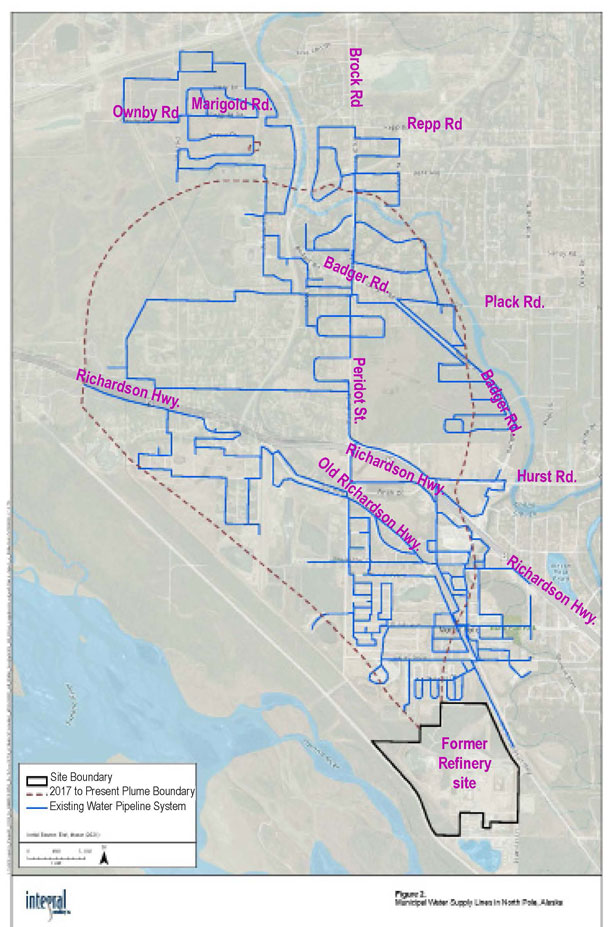
Map showing approximate boundaries of the sulfolane plume
The map shows the approximate boundaries of the sulfolane plume based on results of groundwater sampling done from 2017 to 2024. It also shows the City of North Pole's municipal water supply lines. Additional maps showing sampling results and indication of the plume boundary over time are available from the Maps page. Larger size of map
Map showing locations of groundwater sampling for PFOS and PFOA
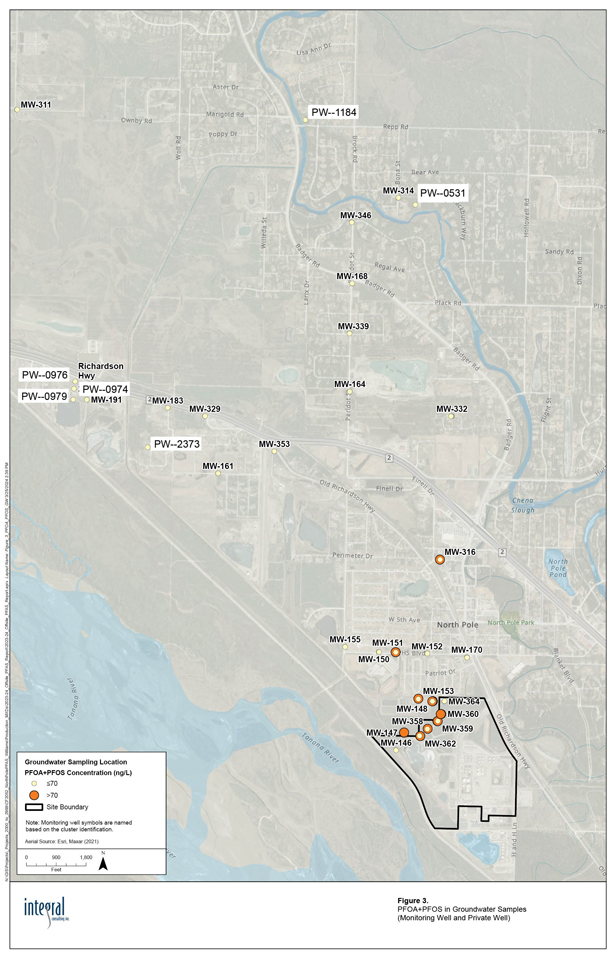
The map shows locations of groundwater sampling for two PFAS (PFOA and PFOS) in monitoring wells (marked “MW”) and some private wells (“PW”), along with the relative concentrations found in 2023/ 2024.
Williams’ sampling found PFAS in groundwater above the DEC action level of 70 parts per trillion, or nanograms per liter (ng/L), for PFOA + PFOS in some monitoring wells north of the former refinery. The DEC action level applies to groundwater and surface water used as drinking water.
Additional maps showing sampling results and indication of the plume boundary over time are available from the Maps page. Larger size of map
Key Contacts
City of North Pole
- City of North Pole, Water & Sewer Utility
- Paul Trissel
- Utilities Supervisor
- 125 Snowman Lane, North Pole, AK 99705
- 907-488-8593
DEC, Drinking Water Program
- Division of Environmental Health
- Cindy Christian
- Manager, Field Operations
- 907-451-2138
DEC, Contaminated Sites Program
- DEC, Division of Spill Prevention and Response
- Axl Levan (rev. May 1, 2025)
- Environmental Program Specialist and Project Manager
- 907-451-2156
 Indicates an external site.